
How to Choose a Workout Program
By Jordan Hoppel · · Updated · 7 min read
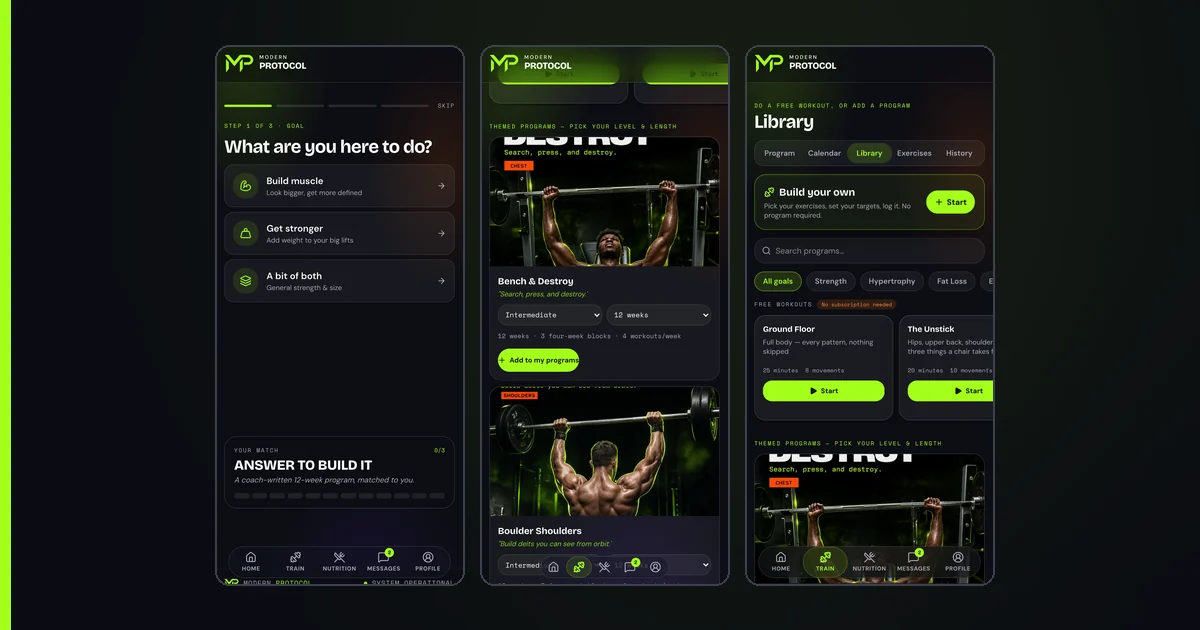
Start with three questions: what are your top three goals in order, what have you been doing, and what schedule can you fully keep. Then match the program to the goal, because strength, muscle size and fat loss each call for different choices. A program handed to everyone with nothing individualized is cheap and dishonest.
"I don't know what program to pick" is the most common thing new lifters tell me. My answer is never a program name. It is a short set of questions, because I believe the right program depends on the person.
Principles are few, methods are many. The methods I use are dictated by each person's individual situation, and everyone has uniqueness about them.
What should you ask before choosing a program?
Ask what your top three goals are, what you have been doing, and what schedule you can fully keep.
- What are your top three goals, in order? Ranking them tells me where the emphasis goes.
- What have you been doing leading up to now? That is the starting point. A program has to begin where you actually are, not where you wish you were.
- What is your schedule and availability to train? I don't want anyone committing to a schedule they can't completely fulfill. A program you can only half follow is worse than a smaller one you can follow fully.
If you can answer those three honestly, you already know more about what you need than most people who go shopping for a program.
Three examples of the questions at work
These are made-up examples to show how the questions steer the choice.
- A new lifter with three evenings free. Top goals: get stronger, then lose some fat. Has never trained. Three evenings a week. The answers point to a beginner program of about three full-body days, with strength first. See the beginner lifting guide.
- A returning lifter who trained for years and stopped. Top goal: build muscle. Has been inactive. Four days available. The answers point to a four-day split that starts lighter than their old numbers, because a program has to begin where you are now.
- A runner who wants to be stronger. Top goal: strength without hurting running. Runs four days. Two days free. The answers point to a small program of two lifting days, because the schedule decides the size of the program.
Which program fits strength, muscle or fat loss?
Strength calls for more sets of fewer reps, muscle size for sets taken close to failure, and fat loss for energy out above energy in. I am quick to say these are rules of exercise science and biology more than my own rules.
| Goal | What the training looks like |
|---|---|
| Strength | More sets, fewer reps. Take advantage of recovery. Don't go to failure often, so the nervous system stays fresh. |
| Muscle size (hypertrophy) | Similar methods, but you take the muscle into mechanical tension and get close to failure. |
| Fat loss | Energy out has to be greater than energy in. Keep protein high to hold onto muscle and to help you stick to the diet, since protein keeps you full longer. |
Notice that strength and size overlap a lot. The biggest difference is how hard you push each set: strength work stops short of failure, size work gets close to it. The rep ranges behind each goal are in rep ranges for strength and muscle.
How many days a week should a program ask for?
Beginners stay toward 3 to 4 days, and more advanced lifters move toward 5. Goal, schedule, training age and experience all feed into the number. This is covered in full in how many days a week to lift.
What is the most common mistake when choosing a program?
Not really choosing. In my experience, most people don't really pick a program. They follow random advice from social media, or from people with good physiques. That advice isn't always bad, but it isn't rooted in biomechanics or individual differences.
People tend to pick on vibes. My alternative is to look at three things:
- Who is writing the program. Their experience matters. A strength coach has seen many archetypes, so a coach's experience is a much sounder basis than a physique.
- Whether it fits your goals. A program built for a different goal will not get you to yours.
- Whether it is individualized. My view of coaches who hand everyone the same program with nothing adjusted is blunt:
It's cheap, it's dishonest.
From answers to a program: a simple order of decisions
Once you have your three answers, the rest of the choice follows in a fixed order. Working top to bottom keeps you from choosing a split before you know your schedule.
- Write down the goals, ranked. Strength, muscle size and fat loss each point to different training. The table above shows how.
- Write down what you have been doing. A program starts where you are. If you have never lifted, read the beginner lifting guide.
- Count the days you can fully keep. Be honest. See how many days a week to lift for how that number shapes the layout.
- Pick the effort style for the goal. Strength work stops short of failure; size work gets close to it. The ranges are in rep ranges for strength and muscle.
- Decide how it will progress. Add reps first, then weight, in small steps. See progressive overload explained.
- Commit to a full block. Eight to twelve weeks, then review. See how long to stick with a workout program.
- Keep a record. You cannot review what you did not write down. See how to track your workouts.
How the goal changes the details
| If your top goal is | Training leans toward | Where to read more |
|---|---|---|
| Strength | Sets of 3 to 5 reps, stopping short of failure so the nervous system stays fresh | Rep ranges |
| Muscle size | Sets of about 6 to 12 reps taken close to failure | Rep ranges |
| Fat loss | Lifting to keep muscle, with protein high and energy out above energy in | How to eat for muscle |
| Getting started | Learning the movement patterns before adding load | Beginner lifting guide |
Strength and muscle size overlap more than most people expect. What changes between them is how hard you finish each set, not the exercises themselves.
Why does recovery matter when choosing a program?
A program is only as good as your ability to recover from it. My frequency rule is that training cannot outpace recovery if you want continued quality progress. That is why the schedule question matters as much as the goal question, and why sleep belongs in the decision. See sleep for lifters and what a deload week is for the signs that a program is asking too much.
Why in-person experience matters
I point out that a lot of online coaches have never trained people in person, and I have trained people almost exclusively in person. My own background includes being an All-American sprinter in college. It's a fair question to ask of anyone writing your program: how many real people have they coached, and what did they change when something didn't work?
Learn enough to not get steered wrong
You don't need a degree, but I want people to have some understanding of strength training and exercise physiology so they don't get steered down the wrong path. Knowing why a program is built the way it is makes you a harder person to sell nonsense to.
What to ask about any program
Whether it is an app, a PDF or a coach, these questions separate a program from a collection of workouts:
- Who wrote it, and who have they coached? Experience with real people matters more than a photo.
- What goal is it built for? A strength program and a fat-loss program are different documents.
- How does it progress from week one to the last week? If it does not say, it is not a progression.
- What happens when you miss a session or hit a plateau? A good program has an answer.
- Is it written for you, or for everyone? My view of one program for everyone is quoted above.
What are the red flags in a workout program?
- The same program handed to everyone, with nothing individualized.
- A program chosen because of the author's physique alone.
- No explanation of how the weeks differ.
- Nothing about schedule, recovery or what to do when life gets in the way.
Should you use a program, an app or a coach?
A program is the cheapest and least personal option; a coach who watches you train is the most individualized. My own offering covers all three: in-person coaching, a training app and online coaching. I run all of them, so this section describes my own work and is not a neutral comparison. The questions in this guide apply to any coach or app you consider, including mine.
What if you picked the wrong program?
Choosing is not permanent. If you finish a full block and your answers to the three questions have changed, choose again with the new answers. Switching after a full block is different from switching every two weeks, as how long to stick with a workout program explains.
Once you've chosen
Give the program a fair run. My guidance is 8 to 12 weeks for a first program, explained in how long to stick with a workout program.
Frequently asked questions
What are the first questions to ask when choosing a program?
I ask three: what are your top three goals in order, what have you been doing leading up to now, and what is your schedule and availability to train. I don't want clients committing to a schedule they can't completely fulfill.
Is it okay to follow a program from someone with a great physique?
Their advice isn't always bad, but it isn't rooted in biomechanics or individual differences. I recommend looking at who is writing the program, their experience level, and whether it fits your goals.
Should everyone run the same program?
No. My philosophy is that principles are few and methods are many, and the methods are dictated by each person's individual situation.
New lifting guides every week
Short training clips and the numbers behind them. Follow along or start training free.
Keep reading
How Long Should You Stick With a Workout Program?
Why a first program needs 8 to 12 weeks, what you miss when you switch after week one, and why early gains are mostly neurological, not muscle.
How Many Days a Week Should You Lift? 3 vs 4 vs 5
A strength coach on choosing 3, 4 or 5 training days, how to split them, and why how fast you recover sets the ceiling on training frequency.
Progressive Overload Explained (and What to Do When It Stalls)
Progressive overload in plain terms: add reps first, then weight, how much to add as a beginner, and how to push past a plateau with tempo and pauses.