
Beginner Lifting Guide: What a Coach Does in Your First Weeks
By Jordan Hoppel · · Updated · 6 min read
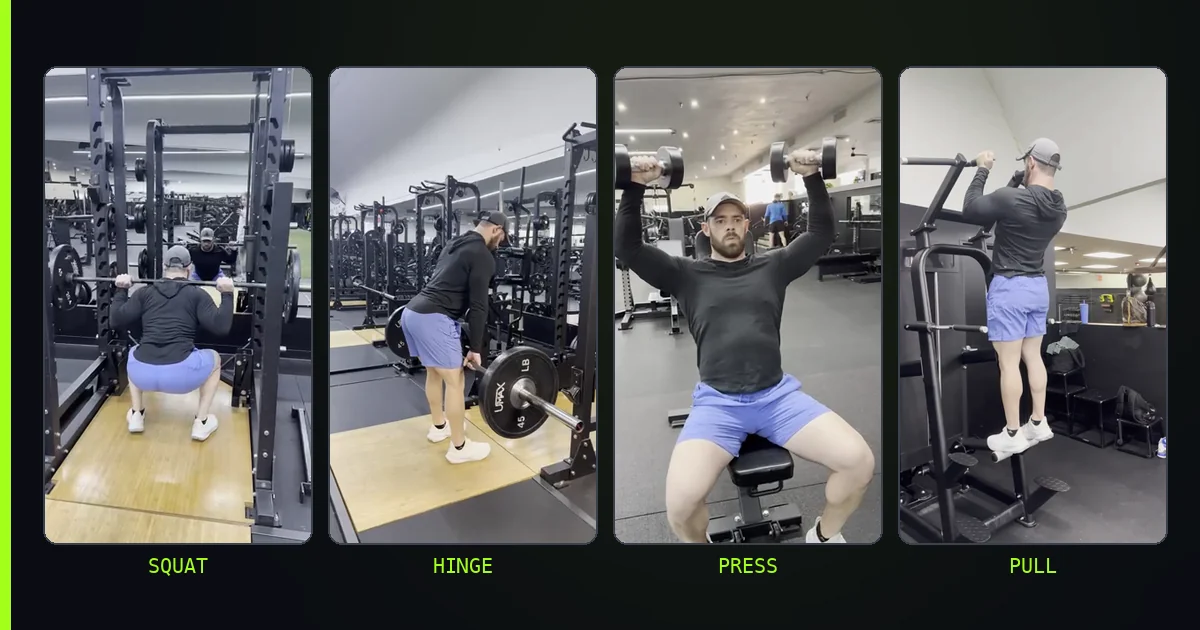
Start with an exploratory first week: I watch how you move, then take you through 5 to 15 exercises or machines for 1 to 3 sets each. Learn movement patterns before specific lifts, train 3 to 4 days a week, add 5 pounds per set, 10 at most, and perfect the fundamentals first.
Here is how I start true beginners: who I count as one, what you need, what the first week looks like, and which movements I teach.
Are you a true beginner?
A true beginner is someone who has never played a sport, done anything physical with their body, or formally lifted weights. Gym class in middle or high school doesn't count. If you have any of that background, you are not a true beginner, and the starting point looks different.
What do you need to start lifting?
Nothing tangible. If you're training with a coach or in a gym, you need:
- appropriate clothing and footwear,
- a good attitude,
- an open approach, and
- high trait openness to training, coaching and working out.
That last item is the one I emphasize. The best clients are willing to work hard, learn, and be open to suggestion and to trying things that may seem unconventional but are rooted in sound logic and first-principles thinking.
What should your first week of lifting look like?
My first week is exploratory, because there's no standard beginner week when goals differ. I watch how a person moves naturally without my guidance, their natural tendencies in movement patterns, and what they're capable of before giving instruction.
Then I take them through about 5 to 15 exercises or machines, 1 to 3 sets each. I note three things: performance, whether they like it, and form. That gives me a baseline for programming.
Which movements should a beginner learn first?
Learn the basic movement patterns before specific lifts. I teach movement patterns more than lifts, and my choices depend on experience level, training age, overall age and injuries. I want to see each of these:
| Pattern | Plain description |
|---|---|
| Squat | Sitting down and standing back up with the weight. |
| Hinge | Bending at the hips, such as a deadlift. |
| Lunge | A split stance, stepping or lowering on one leg at a time. |
| Overhead press | Pushing weight above the head. |
| Overhead pull | Pulling something down from above, such as a pull-up. |
| Horizontal press and pull | Pushing away from and pulling toward the torso. |
| Lying-on-the-back push | A pressing pattern done lying down, such as a bench press. |
The reason for starting with patterns is that they show natural tendencies. The specific lifts used depend on experience level.
Your first four weeks, in outline
This outline follows my approach, but a real plan depends on your goals, so a coach's version will differ.
- Week 1: explore. Move through 5 to 15 exercises or machines, 1 to 3 sets each, so the baseline is set.
- Weeks 2 to 4: practice the patterns. Use light weights and focus on smooth, controlled reps in the squat, hinge, press and pull patterns.
- Add weight slowly. Use the 5 pound steps, 10 at most, once the movement looks and feels right.
- Write it down. Even a simple note on what you did helps. See how to track your workouts.
Does soreness mean a workout worked?
No. Expect to feel sore, especially early on, and do not read it as a score. My view is that soreness is a response to stress and a byproduct of workouts in general, not a predictor of a good one. Researchers who reviewed the evidence on soreness came to the same view: it is a weak guide to progress, so the absence of aches does not mean a session failed (Schoenfeld and Contreras, 2013). A hard session does not need to hurt the next day to count.
How many days a week should a beginner lift?
Beginners stay toward 3 to 4 days a week, on a schedule they can actually keep. Before any program, I ask about your schedule and availability to train, because I don't want you committing to something you can't completely fulfill. See how many days a week to lift.
How much weight should a beginner add?
Beginner jumps are small: 5 pounds, 10 at most, per set. The numbers, and what to do when they stop working, are in progressive overload explained.
What should you do if you stall as a beginner?
Look at your form first, because a beginner stall is usually a technique flaw. You may not be positioning the body correctly, using the correct muscles in the right order, or moving smoothly. Fixing a beginner stall starts with looking at the lift, not adding more.
How fast will a beginner get stronger?
Progress is fast at first, then it slows. In a small study of 15 young adults on an 8-week program, most of the early strength gain came from neural factors, with muscle growth taking over after roughly 3 to 5 weeks (Moritani and deVries, 1979). That matches my warning that beginners assume the early pace will continue when it will not. Expect the rate to slow, and judge your program over a full block, not a few sessions. See how long to stick with a workout program.
How do you know a beginner program is working?
My test is simple. If the weights you are moving go up according to the schedule and progression you should be following, every week, you are getting stronger. Feelings and soreness are not the test. If the numbers stop rising, go back to the basics first: look at your form, then your sleep and recovery, before you add more work. See why your squat stopped going up for the order I check.
When should a beginner get help from a coach?
If a lift feels awkward, your body is not moving smoothly, or you stall early, have someone who coaches watch you do it. Form problems are hard to see from the inside. That is the case for in-person coaching: I have trained people almost exclusively in person, and the first week of my process is built around watching how you move.
A short beginner checklist
- Learn the movement patterns before chasing weight.
- Keep to a schedule you can fully keep, usually 3 to 4 days.
- Add 5 pounds at a time, 10 at most.
- Write down what you did.
- Expect the early pace to slow down.
- Ask for a coach's eyes on your form early.
Questions to ask a coach or gym before you start
- How many people have you coached in person, and what do you do when someone's lift stalls?
- How is the program individualized for me?
- What will the first week look like?
My advice is to look at who is writing the program and how much real coaching experience they have. See how to choose a workout program.
Fundamentals first
The one thing I want every lifter to understand in the first year is how important the fundamentals are, and to perfect them before moving on to anything more advanced. Beginners get rapid gains early and get excited, so they assume they'll keep advancing at that rate. That's just not the case. The one-page version of this advice is in advice for new lifters.
Sources
- Schoenfeld BJ, Contreras B. Is postexercise muscle soreness a valid indicator of muscular adaptations? Strength Cond J. 2013;35(5):16-21. doi:10.1519/SSC.0b013e3182a61820
- Moritani T, deVries HA. Neural factors versus hypertrophy in the time course of muscle strength gain. Am J Phys Med. 1979;58(3):115-130. PubMed 453338
Frequently asked questions
Who counts as a true beginner?
Someone who has never played a sport, done anything physical with their body, or formally lifted weights. Gym class in middle or high school doesn't count.
What do I need before starting?
Nothing tangible. If training with a coach or in a gym: appropriate clothing and footwear, a good attitude, an open approach, and high trait openness to training and coaching.
What does a beginner's first week look like?
There's no standard week since goals differ. My first week is exploratory: watching how you move naturally, then taking you through about 5 to 15 exercises or machines, 1 to 3 sets each.
Why does a beginner's lift stall?
Usually it's form-related: a technique flaw. The body may not be positioned correctly, the correct muscles may not be used in the right order or context, or the movement may not be coordinated or smooth.
Which movements do you teach first?
I teach movement patterns more than lifts: squat, hinge, lunge, overhead press, overhead pull, horizontal press and pull, and a lying-on-the-back pushing pattern.
New lifting guides every week
Short training clips and the numbers behind them. Follow along or start training free.
Keep reading
Advice for New Lifters: The One-Page Version
A strength coach's one page of advice for new lifters: stay consistent within a sustainable range, don't progress too fast, and never trade form for gains.
Progressive Overload Explained (and What to Do When It Stalls)
Progressive overload in plain terms: add reps first, then weight, how much to add as a beginner, and how to push past a plateau with tempo and pauses.
How to Choose a Workout Program
Three questions a strength coach asks before picking a program, how goals change the training, and the mistakes that send people to the wrong one.