
How Long Should You Stick With a Workout Program?
By Jordan Hoppel · · Updated · 4 min read
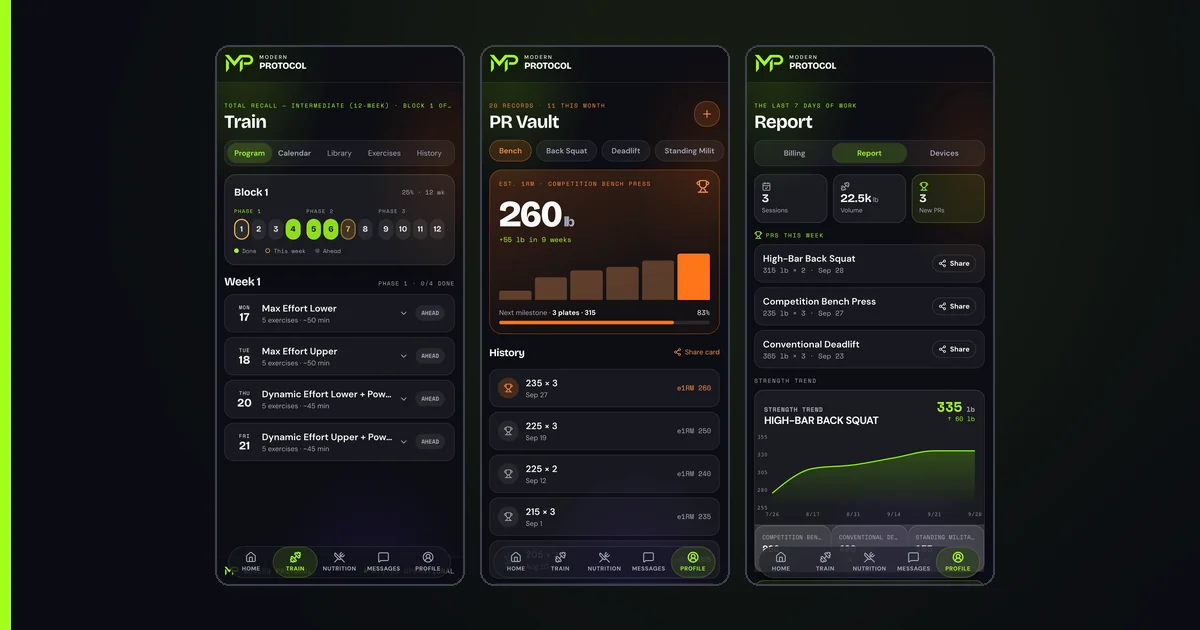
Give a first program 8 to 12 weeks. A periodized program changes reps, sets and exercises from the first week to the last for a reason, so doing only week one of each program means you never see how it progresses. Early gains are mostly neurological, so changes in the muscle itself take longer to show.
If you switch programs every couple of weeks, you aren't really following a program at all. I explain how long to commit and what you miss when you don't.
How long should you stick with a workout program?
For a first program, I want people to give it 8 to 12 weeks. The reason comes from how a good program is built.
Can you judge a program after one week?
No. In a periodized program, reps, sets and exercises change from the first week to the last, and they change for a reason. If you only do week one of every program, you never see how the program is designed to progress. You judge the opening move of a plan that was built to be read as a whole.
A strength block, for example, can start with higher reps and more total volume, then move toward heavier weights with fewer reps, and finish with fast, dynamic work. Week one of that plan looks nothing like week eight, so week one can't tell you whether week eight is going to work.
Why is early progress misleading?
Because early progress is mostly your nervous system, not your muscle, and the body needs time for tissues to adapt. I explain that early on, most progress is neurological, not muscular, even though people often credit the muscle. You get better at the movement and at recruiting the muscle you already have.
Because of that, it takes longer for changes to take hold in the muscle itself. This is also why beginners are often surprised when fast early gains slow down. As I say in my advice to new lifters, rapid early gains are normal and they don't continue at that rate. Plan for the slower part, because that is where most of the program lives.
What happens if you take time off?
If your training age is higher and you have trained consistently, you come back quickly. Time spent training has a payoff beyond the program itself. Once training age is higher and training is consistent, readjusting after time off is much quicker.
The rebound is really quick.
So a missed week or a break doesn't erase what you built. It makes sense to commit to the plan, because the consistency keeps paying you back even when life interrupts.
What 8 to 12 weeks is actually asking of you
My picture of a strength block shows why the length matters: it starts with higher reps and more total volume, moves toward heavier weights with fewer reps, and finishes with fast, dynamic work. Each stage sets up the next one. Cut a program off after two weeks and you have only done the setup.
A fair review of a program happens at the end of the block, not in the middle. Ask three questions:
- Did the weights go up on the schedule the program laid out?
- Could you complete the sessions with energy and good form?
- Did you actually follow it? Count the sessions you finished against the sessions planned.
If the answers are yes, yes and yes, the program worked and the next one can build on it. If the answer to the third is no, the program has not really been tested yet.
When does muscle growth take over from early gains?
In one small study, muscle growth took over after roughly 3 to 5 weeks. That 1979 study of 15 young adults found neural factors drove most of the strength gain at first, as the nervous system learned the movement (Moritani and deVries, 1979). That is the practical reason a program judged at week three can look better than it is, and one judged at week six can look worse than it will.
When should you switch programs?
Switch only after you have finished the block, recovered, and tracked enough to judge it. A few checks before you abandon a program:
- Have you finished the block? Judge it across all 8 to 12 weeks, not on how week one felt.
- Are you recovered? If sleep is poor and sessions feel like a grind, that is a recovery question, not a program question. See what a deload week is.
- Are you tracking it? You can't see a progression you aren't writing down. See how to track your workouts.
If you're not sure the program fit you in the first place, start with how to choose a workout program.
Sources
- Moritani T, deVries HA. Neural factors versus hypertrophy in the time course of muscle strength gain. Am J Phys Med. 1979;58(3):115-130. PubMed 453338
Frequently asked questions
How many weeks should I run a program before switching?
I recommend 8 to 12 weeks for a first program.
Why does program-hopping not work?
In a periodized program, reps, sets, and exercises change from the first week to the last for a reason. If you only do week one of every program, you never see how it's built to progress.
Why do I get strong before I look bigger?
Early on, most progress is neurological, not muscular, even though people often attribute it to the muscle. It takes longer for changes to take hold in the muscle.
How fast do I bounce back after time off?
Once training age is higher and training is consistent, readjustment after time off is much quicker. In my words, 'the rebound is really quick.'
New lifting guides every week
Short training clips and the numbers behind them. Follow along or start training free.
Keep reading
How to Choose a Workout Program
Three questions a strength coach asks before picking a program, how goals change the training, and the mistakes that send people to the wrong one.
What Is a Deload Week? How to Run One and When You Need It
A deload cuts volume in half and keeps intensity the same. How to run one, and the signs, like poor sleep and stalled numbers, that you need it.
Progressive Overload Explained (and What to Do When It Stalls)
Progressive overload in plain terms: add reps first, then weight, how much to add as a beginner, and how to push past a plateau with tempo and pauses.