
What Is a Deload Week? How to Run One and When You Need It
By Jordan Hoppel · · Updated · 3 min read
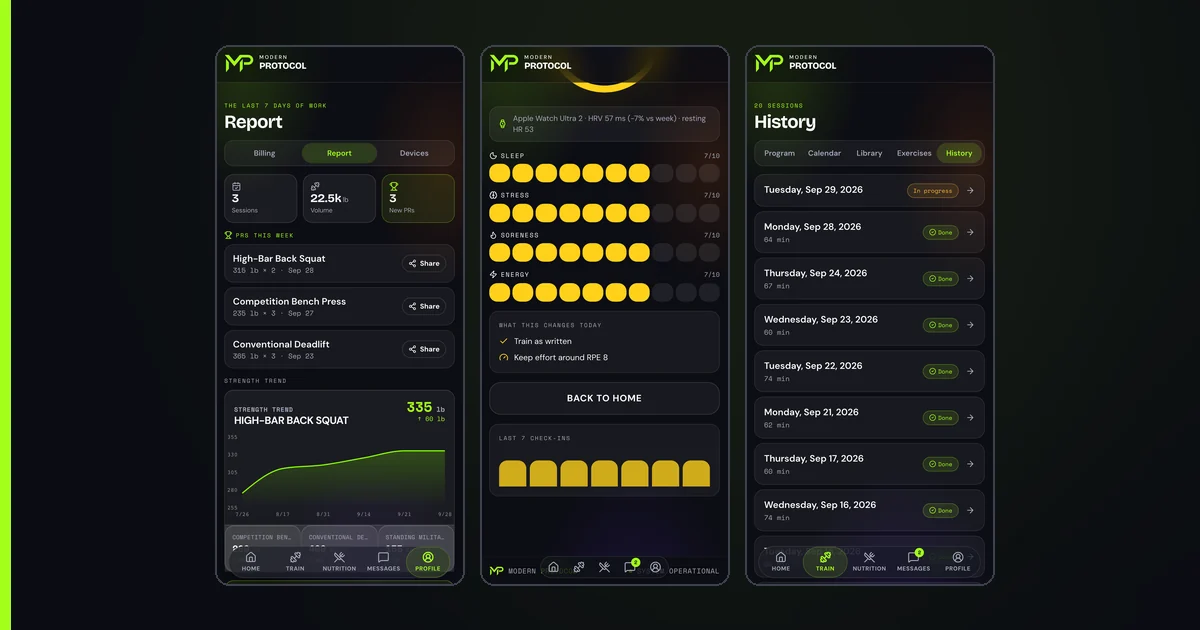
A deload week is a planned lighter week: cut your sets in half and leave the weights where they are, so volume drops while intensity stays about the same. I watch for poor sleep, sessions that feel like a grind, feeling worn out, and numbers that trend down or have not risen in a long time.
A deload is a planned lighter week. I keep my definition simple, and so is my rule for knowing when to use one.
How do you do a deload week?
Cut your sets in half and keep the weights the same. Drop the volume; keep intensity generally the same.
For example, if you normally do 4 sets of 5 at 225 pounds, a deload week is 2 sets of 5 at 225. The bar still feels familiar, but you do half the work.
| Normal week | Deload week | |
|---|---|---|
| Sets | 4 | 2 |
| Reps per set | 5 | 5 |
| Weight | 225 lb | 225 lb |
| Total reps | 20 | 10 |
How do you know you need a deload?
I look for a cluster of signs, not one bad day:
- You report poor sleep.
- Training feels like a grind.
- You feel worn out.
- Your numbers trend downward, or haven't trended upward in a very long time.
In maintenance or in-season phases the goal isn't getting stronger, just recovering from game to game, so the logic shifts: you are managing freshness, not chasing numbers.
How often should you deload?
There is no fixed rule: I deload when the signs above show up. For comparison, a survey of 246 competitive strength and physique athletes found that all of them deloaded, typically for about 6 days roughly every 5 to 6 weeks. Volume dropped through fewer reps and fewer sets while training frequency stayed the same, and the most common reason was managing fatigue (Rogerson et al., 2024). It is a survey of habits, so it shows what lifters do, not that deloading is proven to work.
What a fatigued lifter is usually dealing with
When a lift stalls and the signs above are present, my usual explanation is that the nervous system is fatigued. Overtraining, under-recovery and an injury the lifter hasn't noticed can all sit behind it. For a worked example on one lift, read why your squat stopped going up.
Does soreness mean you need a deload?
Not really. Soreness is a response a muscle experiences after being placed under stress. It's not necessarily a predictor of a good workout; it's a byproduct of workouts in general. A review of the research reaches a similar conclusion: soreness is an unreliable indicator of muscle damage and of whether you are adapting (Schoenfeld and Contreras, 2013). So being sore is not a reason to deload, and not being sore is not a reason to push harder.
What a deload week looks like
During a deload, the weights stay the same and the sets are cut in half. That keeps the movements familiar while the work falls by half. A survey of 246 competitive strength and physique athletes found a similar pattern: volume fell through fewer sets and reps while training frequency stayed unchanged (Rogerson et al., 2024).
Should you plan deloads or wait for signs?
Either can be reasonable; my method is sign-based. Most athletes in that survey planned their deloads in advance, about every 5 to 6 weeks, though some also used them when performance stalled. About 65 percent said they could progress without deloads at all. I watch for poor sleep, a grind, feeling worn out and numbers that stall. The survey cannot say which approach works better, so whichever you use, watch the same signs.
Can poor sleep mean you need a deload?
Yes. Poor sleep is the first sign on my list for a reason. Sleep is critically important for everything to do with fitness, so before you change the plan, check your nights. See sleep for lifters.
Is it a deload problem or a real plateau?
If you're recovered and the weights still don't move, that's a training plateau, not a recovery problem. See progressive overload explained for what to change.
Sources
- Rogerson D et al. Deloading practices in strength and physique sports: a cross-sectional survey. Sports Med Open. 2024;10:26. doi:10.1186/s40798-024-00691-y
- Schoenfeld BJ, Contreras B. Is postexercise muscle soreness a valid indicator of muscular adaptations? Strength Cond J. 2013;35(5):16-21. doi:10.1519/SSC.0b013e3182a61820
Frequently asked questions
What is a deload week?
My version: drop the volume. Keep intensity generally the same, but cut volume in half.
How do I know I need a deload?
You report poor sleep, training feels like a grind, you feel worn out, and your numbers trend downward or haven't trended upward in a very long time.
Does muscle soreness mean I had a good workout?
Soreness is a response a muscle experiences after being placed under stress. It's not necessarily a predictor of a good workout; it's a byproduct of workouts in general.
Do I deload in-season or in a maintenance phase?
In maintenance or in-season phases you're not trying to get stronger, just to recover from game to game.
New lifting guides every week
Short training clips and the numbers behind them. Follow along or start training free.
Keep reading
Sleep for Lifters: Why It Matters and How to Fix Bad Sleep
Why sleep is critical for training and a coach's practical fixes for bad sleepers: routine, a cool room, a hot shower, less light, and what to eat.
Progressive Overload Explained (and What to Do When It Stalls)
Progressive overload in plain terms: add reps first, then weight, how much to add as a beginner, and how to push past a plateau with tempo and pauses.
How Many Days a Week Should You Lift? 3 vs 4 vs 5
A strength coach on choosing 3, 4 or 5 training days, how to split them, and why how fast you recover sets the ceiling on training frequency.