
Best Rep Ranges for Strength, Muscle and Endurance
By Jordan Hoppel · · Updated · 4 min read
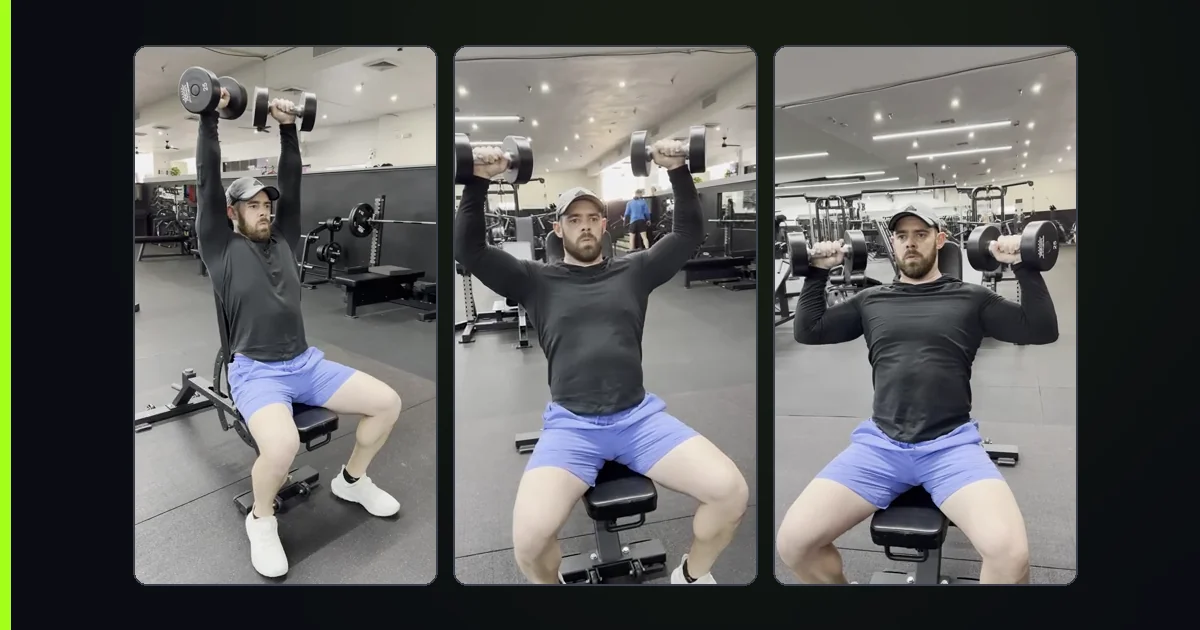
Use 3 to 5 reps for strength, typically 6 to 12 for muscle size, and 30 or more for endurance. For size, the closer a set is to failure, the higher the mechanical tension, and tension matters more than the pump. For strength, complete the programmed reps instead of training to failure.
Rep ranges decide what a set trains. I break them down by goal and explain why the number on the screen is not the whole story.
| Goal | Reps | Notes |
|---|---|---|
| Strength | 3 to 5 | Don't go to failure often; complete the programmed reps. |
| Muscle (hypertrophy) | 6 to 12 typically | Get close to failure; can range from 5 to 30. |
| Endurance | 30+ | More aerobic than anaerobic. |
What is the best rep range for strength?
Use 3 to 5 reps per set, and finish the programmed reps instead of going to failure. My shorthand is the three to five method: 3 to 5 exercises, 3 to 5 sets, 3 to 5 reps, 3 to 5 days a week. Strength work is task-driven: a certain weight for a certain number of reps.
The effort level matters as much as the reps. In strength training you are not trying to reach failure. The more you go to failure in strength work, the more it works against you and the more you plateau. You want to complete the programmed reps and keep the nervous system fresh.
What is the best rep range for muscle growth?
Hypertrophy is typically 6 to 12 reps, but it's very individual. Proximity to failure is easier to measure around 6 to 8 reps than at 10 to 12. You can go as low as 5 or as high as 30 reps as long as proximity to failure is the same. The research backs the wide range: a meta-analysis found that low-load and high-load training build similar muscle when sets were taken to failure, while heavier loads gave clearly bigger strength gains (Schoenfeld et al., 2017). That matches my 3 to 5 reps for strength.
People think they need higher reps than they do because the pump and blood flow feel like it's working more, but mechanical tension is the main driver.
The closer a set is to failure, the higher the mechanical tension. So the pump is a poor guide to how effective a set was.
What rep range builds muscular endurance?
30 reps and over, which is more aerobic than anaerobic.
Strength vs. size: same percentages, different effort
I use mostly the same percentages for strength and for size. The difference is how close to failure you finish the set. In strength work you stop with the programmed reps completed. In hypertrophy work you get close to failure. A meta-analysis of 15 trials found no evidence that training to momentary failure beats stopping short of it for muscle growth (Refalo et al., 2023), which fits my advice not to chase failure for strength. For how percentages work, see one-rep max percentages explained.
What does "close to failure" mean?
Failure is the point where you cannot complete another rep with good form. Lifters often describe how close they stop with "reps in reserve": a set of 10 that ends with 2 reps left in the tank has 2 reps in reserve. My point is that proximity to failure is easier to judge around 6 to 8 reps than around 10 to 12.
The same lift for three goals
| Goal | Example sets and reps | How hard the last rep is |
|---|---|---|
| Strength | 4 sets of 4 | Finish the programmed reps; do not grind. |
| Muscle size | 3 sets of 8 | Stop close to failure. |
| Endurance | 2 sets of 30 | Steady and aerobic. |
These are examples that follow my ranges, not set prescriptions. The reps differ, and so does the effort.
Choosing a range in practice
- Decide the goal first: strength, size or endurance.
- Pick the range for that goal.
- Decide how close to failure you will finish the sets.
- Progress by adding reps first, then weight. See progressive overload explained.
Sources
- Schoenfeld BJ, Grgic J, Ogborn D, Krieger JW. Strength and hypertrophy adaptations between low- vs. high-load resistance training: a systematic review and meta-analysis. J Strength Cond Res. 2017;31(12):3508-3523. doi:10.1519/JSC.0000000000002200
- Refalo MC, Helms ER, Trexler ET, Hamilton DL, Fyfe JJ. Influence of resistance training proximity-to-failure on skeletal muscle hypertrophy: a systematic review with meta-analysis. Sports Med. 2023;53(3):649-665. doi:10.1007/s40279-022-01784-y
Frequently asked questions
What rep range is best for strength?
I use 3 to 5. My 'three to five method' is 3 to 5 exercises, 3 to 5 sets, 3 to 5 reps, 3 to 5 days a week.
What rep range is best for muscle growth?
Typically 6 to 12, and very individual. You can go as low as 5 or as high as 30 reps as long as proximity to failure is the same.
Why do people think they need higher reps?
The pump and blood flow feel like the muscle is working more, but mechanical tension is the main driver, and the closer to failure, the higher the tension.
Should I train to failure for strength?
Not often. The more you go to failure in strength training, the more it works against you and the more you plateau. You want to complete the programmed reps.
New lifting guides every week
Short training clips and the numbers behind them. Follow along or start training free.
Keep reading
One-Rep Max Percentages Explained (and When to Test Your Max)
A training percentage is intensity, not effort. See how a 325 lb max turns into working weights, and when a coach tests a true max versus a 3 or 5 rep max.
Progressive Overload Explained (and What to Do When It Stalls)
Progressive overload in plain terms: add reps first, then weight, how much to add as a beginner, and how to push past a plateau with tempo and pauses.
How to Squat 315 From 225: A 12-Week Tempo Plan
An example plan for taking a 225 lb squat toward 315: a technique block, slow 4 to 5 second lowers, one-and-a-quarter squats and a week 13 test.