
One-Rep Max Percentages Explained (and When to Test Your Max)
By Jordan Hoppel · · Updated · 4 min read
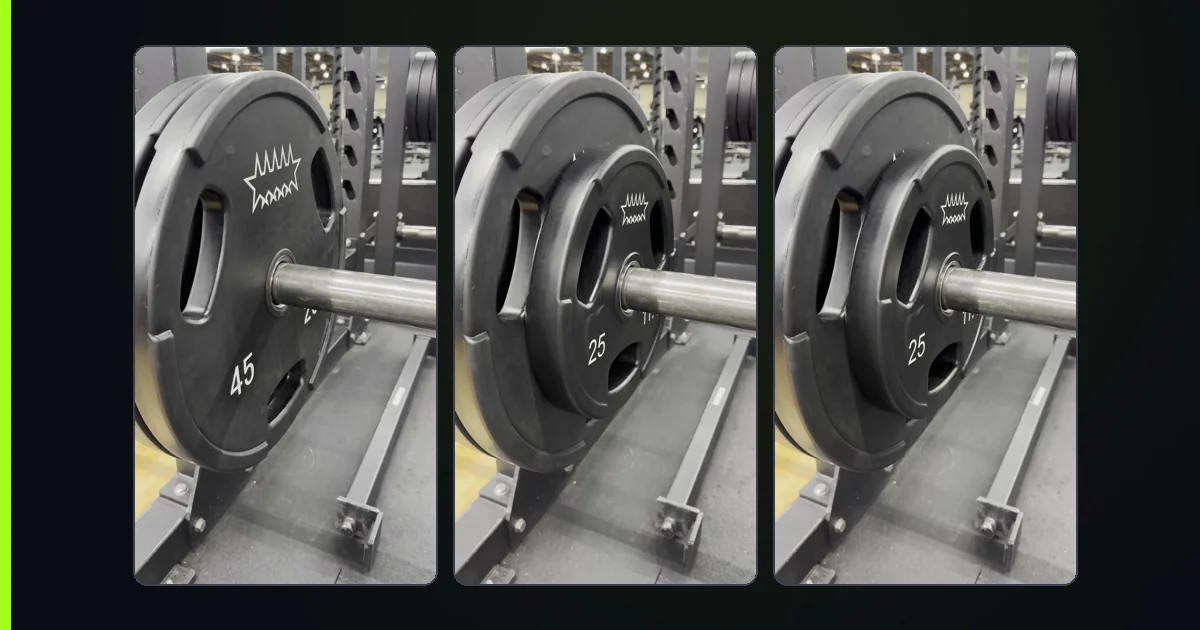
A one-rep max percentage is how heavy the bar is compared with your best single: 80 percent means 80 percent of your max loaded, not 80 percent effort. It points to a rep range you should be able to do: with a 325 lb max, about 250 lb (77 percent) is generally good for 5 to 8 reps.
Percentages of your one-rep max are one of the most misunderstood tools in a program. I clear it up.
Does 80 percent mean 80 percent effort?
No. Training percentage is lifting intensity. It is not aggression or effort, which people often assume. Lifting at 80 percent doesn't mean trying 80 percent as hard. It means the bar is loaded to 80 percent of your best single.
The percentage of your one-rep max gives you a rep range you should be able to do. Two equations cover all the arithmetic:
Weight on the bar = one-rep max × percentage
Percentage = weight on the bar ÷ one-rep max
My example uses a lifter with a 325 pound max, working at about 250 pounds. That is 250 ÷ 325 = 0.77, so about 77 percent, and someone could generally do 5 to 8 reps there. At 70 percent the bar would be 325 × 0.70 = 227.5, about 228 pounds.
A 325 pound max converted to weights
Here is what common percentages come to for a 325 pound max, rounded to the nearest pound:
| Percent | Weight |
|---|---|
| 90% | 293 |
| 80% | 260 |
| 77% | 250 |
| 70% | 228 |
| 60% | 195 |
When you load the bar, round to the nearest weight you can actually put on it. If you are unsure how to build a weight from plates, see barbell plate math.
Do strength and size use different percentages?
Mostly not: I use mostly the same percentages for both, and the difference is effort. In strength work you're not trying to get to failure. In hypertrophy you're going for mechanical tension and getting close to failure. See rep ranges for strength and muscle.
When should you test a true max?
Rarely, and only with a reason. I test true maxes for clients with a specific goal to train their one-rep max and hit a particular number. Otherwise I use a 3-rep or 5-rep max as a proxy for whether they've gotten stronger lift to lift. I stay right around 3 to 5 reps; above that the numbers aren't very reliable.
How do you find your max without testing it?
Estimate it from a recent hard set. For the formulas, see how to calculate your one-rep max or use the 1RM calculator.
How many reps can you do at each percentage?
The heavier the percentage, the fewer reps you can do: roughly 10 reps at 75 percent and about 3 reps at 91 to 94 percent, by the formulas. Percentages and rep counts are two views of the same thing. The formulas in how to calculate your one-rep max can be turned around to show roughly how many reps a given percentage allows.
| Reps | Epley | Brzycki |
|---|---|---|
| 3 | 91% | 94% |
| 5 | 86% | 89% |
| 8 | 79% | 81% |
| 10 | 75% | 75% |
Both formulas agree at 10 reps, where 75 percent of your max is a weight you can lift about 10 times. These are estimates, and their accuracy falls once sets go past about 10 reps (Reynolds et al., 2006).
My example sits in this territory. My 250 pounds on a 325 pound max is about 77 percent. The formulas put roughly 9 reps at that percentage, while my working range is 5 to 8, a more conservative real-world number that leaves room in the tank. That fits my rule for strength work: finish the programmed reps instead of grinding to failure.
A worked example, from a set to the bar
Say your best recent set is 5 reps at 225 pounds. The Epley formula estimates a max of about 262 pounds (225 x 1.167). A working set at 80 percent is then 262 x 0.8 = about 210 pounds. On a 45 pound bar that is 82.5 pounds per side, which is a 45, a 25, a 10 and a 2.5 on each side.
A quick-reference chart
Common percentages of three example maxes, rounded to the nearest pound:
| Max | 60% | 70% | 75% | 80% | 85% | 90% |
|---|---|---|---|---|---|---|
| 200 lb | 120 | 140 | 150 | 160 | 170 | 180 |
| 300 lb | 180 | 210 | 225 | 240 | 255 | 270 |
| 400 lb | 240 | 280 | 300 | 320 | 340 | 360 |
Where percentages fit in a plan
Percentages tell you how heavy to load. They don't tell you how many sets or how hard to push them, which is why I pair them with rep ranges and effort. For the full progression picture, read progressive overload explained.
Sources
- Reynolds JM, Gordon TJ, Robergs RA. Prediction of one repetition maximum strength from multiple repetition maximum testing and anthropometry. J Strength Cond Res. 2006;20(3):584-592. doi:10.1519/00124278-200608000-00020
- Brzycki M. Strength testing: predicting a one-rep max from reps-to-fatigue. J Phys Educ Recreat Dance. 1993;64(1):88-90. doi:10.1080/07303084.1993.10606684
Frequently asked questions
What does training percentage mean?
It is lifting intensity. It is not aggression or effort, which people often assume.
How many reps can I do at about 77%?
My example: with a 325 lb max, a working weight of about 250 pounds (77 percent) is generally good for 5 to 8 reps. For reference, 70 percent of 325 is about 228 pounds.
Do you test true one-rep maxes?
Yes, for clients with a specific goal to train their one-rep max and hit a particular number. Otherwise I use a 3-rep or 5-rep max as a proxy for whether they've gotten stronger lift to lift.
Why not use higher rep maxes?
Above 3 to 5 reps the numbers aren't very reliable.
New lifting guides every week
Short training clips and the numbers behind them. Follow along or start training free.
Keep reading
Best Rep Ranges for Strength, Muscle and Endurance
3 to 5 reps for strength, typically 6 to 12 for muscle and 30 or more for endurance, and why closeness to failure matters more than the pump.
How to Calculate Your One-Rep Max (Without Testing It)
Estimate your 1RM from a lighter set with the Epley and Brzycki formulas. Worked examples, a comparison table, and how accurate the numbers really are.
How to Squat 315 From 225: A 12-Week Tempo Plan
An example plan for taking a 225 lb squat toward 315: a technique block, slow 4 to 5 second lowers, one-and-a-quarter squats and a week 13 test.