
How to Squat 315 From 225: A 12-Week Tempo Plan
By Jordan Hoppel · · Updated · 5 min read
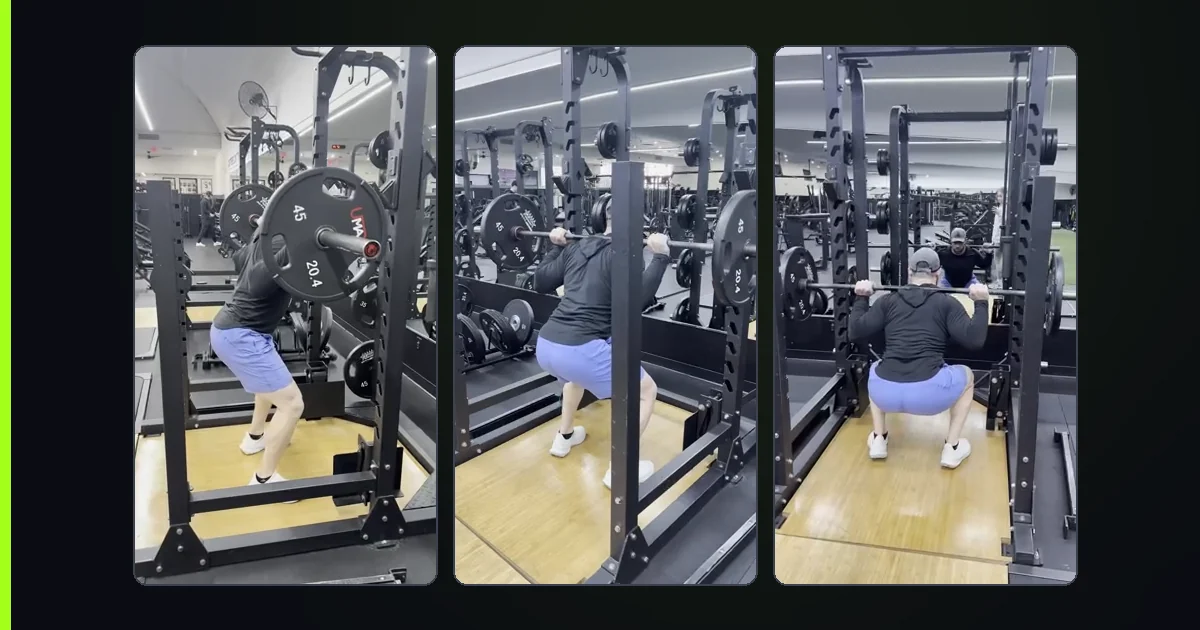
To take a squat from 225 to 315, spend the first 2 to 4 weeks making technique sound at several depths, then use high sets, low reps and a slow 4 to 5 second lowering phase. Later blocks add one-and-a-quarter squats and shorten the tempo, and week 13 is a squat test. Adding 5 pounds per set is feasible, but there is no fixed timeline.
This is my walk-through of how I would take someone with a 225 pound squat toward 315. If someone already squats 225, they've spent some time in the gym or have good genetics for handling training volume. I don't promise a timeline: it depends on training age, genetics and how good the lifter is.
I don't know how long it will take. It depends on training age, genetics, and how good they are.
How to read the plan
A few terms first:
- Sets by reps. "10 sets of 4" means ten sets of four repetitions.
- Eccentric. The lowering part of the squat. A "4 to 5 second eccentric" means you take that long to descend.
- One-and-a-quarter squat. Go all the way down to the lowest good-form depth, come up a quarter of the way, drop back to the bottom, then all the way up.
The plan at a glance
| Phase | What changes |
|---|---|
| Technique (first 2 to 4 weeks) | Make sure technique is sound and the lifter can squat to multiple depths and feel all of them. |
| High-set, low-rep, high-tempo | For example 10 sets of 6 or 10 sets of 4 with a 4 to 5 second eccentric. |
| Tempo plus one-and-a-quarter squats (next 4 weeks) | 8 sets of 5 for the first 2 weeks, then 6 sets of 3 for the next 2 weeks. |
| Shorter tempo (final block) | Eccentric drops from 5 seconds to 3. Keep the quarter squat for the first 2 weeks of the block, then drop the tempo and quarter squat for the last 2 weeks, with 8 sets of 2. |
| Week 13 | Test the squat. |
Phase 1: technique first
Spend the first 2 to 4 weeks on technique. The goal is to squat to multiple depths and feel all of them.
Phase 2: high sets, low reps, slow eccentric
My example is a 135 pound lifter with a 225 pound max. The first 4 sets are at 135 for 4 reps with a 4-second eccentric. The next 6 sets go in pairs, increasing 5 to 10 pounds every two sets. Do this for the first two weeks. After that, drop to 8 sets with the same reps.
As an illustration, if you add 5 pounds each pair, the ten sets look like this:
| Sets | Weight |
|---|---|
| 1 to 4 | 135 |
| 5 and 6 | 140 |
| 7 and 8 | 145 |
| 9 and 10 | 150 |
Each set is 4 reps with the slow eccentric.
Phase 3: add the one-and-a-quarter squat
Over the next 4 weeks, combine the slow tempo with the one-and-a-quarter squat. Do 8 sets of 5 for the first 2 weeks, then 6 sets of 3 for the next 2 weeks.
Phase 4: shorten the tempo
Drop the eccentric from 5 seconds to 3 seconds and keep the quarter squat for the first 2 weeks of the block. For the last 2 weeks, cut the tempo and the quarter squat, keep 8 sets, and drop reps to 2.
Week 13: test the squat
On week 13, test the squat. My way to project where the lifter will end up: going up 5 pounds every set is feasible. Treat the second-to-last set as the previous week's heaviest set, and progress by one or two weight units (one unit is 5 pounds, the next is 10) to project the result after 12 weeks.
How much stronger is a 315 squat than a 225 squat?
It is 90 pounds heavier, a 40 percent increase. Going from 225 to 315 is an increase of 90 pounds, or 40 percent (315 / 225 = 1.4). On the bar, 315 is a bar plus three 45 pound plates on each side, because (315 - 45) / 2 = 135 per side. If you need help loading a bar to a target, see barbell plate math.
The plan also changes how much work you do in a session. Here are the reps per squat session in the blocks I describe, worked out from my set and rep counts:
| Block | Sets and reps | Reps per session |
|---|---|---|
| First two weeks of the high-set phase | 10 sets of 4 | 40 |
| After that | 8 sets of 4 | 32 |
| Tempo plus quarter squat, first 2 weeks | 8 sets of 5 | 40 |
| Tempo plus quarter squat, next 2 weeks | 6 sets of 3 | 18 |
| Last 2 weeks of the final block | 8 sets of 2 | 16 |
Volume falls as the weights climb. That is the pattern I describe for a strength block: heavier weights, lower overall volume, then fast low-rep work at the end.
What weight should you start the plan at?
One way is to start at about 60 percent of your own squat max. My example is a 135 pound lifter with a 225 pound max, so the first working weight is 60 percent of the max (135 / 225 = 0.6). From there, keep the 5 to 10 pound steps. Because everything in the plan hangs on a max, estimate yours first with how to calculate your one-rep max.
Why does this squat plan work?
It follows the same logic as my general approach to stalls: slow lowering and pauses challenge the nervous system when adding weight each week stops working. For the reasoning behind that, see progressive overload explained, and for why a squat stalls to begin with, why your squat stopped going up.
Frequently asked questions
How long will it take to go from a 225 to a 315 squat?
I don't give a fixed time. It depends on training age, genetics, and how good the lifter is.
What is a one-and-a-quarter squat?
Go all the way down to the lowest good-form depth, come up a quarter of the way, drop back to the bottom, then all the way up.
How much weight do I add?
In the example, going up 5 lb every set is feasible. One unit is 5 lb, the next is 10 lb.
Where does the plan end?
Week 13 is a squat test.
New lifting guides every week
Short training clips and the numbers behind them. Follow along or start training free.
Keep reading
Why Your Squat Stopped Going Up (A Coach's Diagnosis)
The main reasons a squat stalls: overtraining, under-recovery, a hidden injury or a fatigued nervous system, and why genetics is rarely the answer.
Best Rep Ranges for Strength, Muscle and Endurance
3 to 5 reps for strength, typically 6 to 12 for muscle and 30 or more for endurance, and why closeness to failure matters more than the pump.
One-Rep Max Percentages Explained (and When to Test Your Max)
A training percentage is intensity, not effort. See how a 325 lb max turns into working weights, and when a coach tests a true max versus a 3 or 5 rep max.