
Strength standards calculator
Enter your age, bodyweight and the lifts you do, and this scores you against standards built for people who train in gyms. You get a tier for each lift from Beginner to Elite, the weight you need for the next tier at 1, 3, 5 and 10 reps, and a read on what you need to lift today to stay strong at 60, 70 or beyond.
About you
Your standards
Enter your age, sex and bodyweight above. Each lift gets five numbers: the middle one is the standard, with two levels below it and two above.
Your standards appear here once you enter your age and bodyweight.
Your lifts
Enter the heaviest set you have done recently and the reps you got. A true one-rep max is 1 rep. Add as many lifts as you like.
Back Squat
Hip crease to or below the top of the knee, then stand to full lockout.
Bench Press
Bar touches the chest, 1-second pause, no bounce, full lockout.
Deadlift
From the floor, dead stop and reset each rep, full hip and knee lockout. No straps (hook or mixed grip is fine), no hitching.
Enter your age and bodyweight to see where you stand.
How the standards work
Every standard is a multiple of your bodyweight. A man who squats 1.6 times his bodyweight and a woman who squats 1.25 times hers are both at the Strong tier for that lift. Age then lowers the bar: from 23 to 40 the standards stay put, and after 40 they come down gradually, so a 60-year-old is scored against a 60-year-old's standard and also shown how that lift compares with prime-age standards.
Your reps are turned into an estimated one-rep max with the Epley formula, the same one in the 1RM calculator. The 3, 5 and 10 rep standards are worked back from that same max, so all four always agree. For pull-ups, chin-ups and dips the same math also gives the number of strict reps at bodyweight that each tier is worth. The dead hang is the one exception: it is scored on time in seconds, not on weight. See how to calculate your one-rep max for the math.
How each lift is judged
Depth and range of motion change a number a lot, so every standard assumes the same execution. Three rules apply to all of them:
- Full range of motion on everything, with one exception: squats go to parallel, hip crease at or below the top of the knee.
- Judge it on video. Film a set from the side. If you cannot tell it met the standard, it did not count.
- A rep that misses the standard does not count. End the set at the first one, and enter only the clean reps.
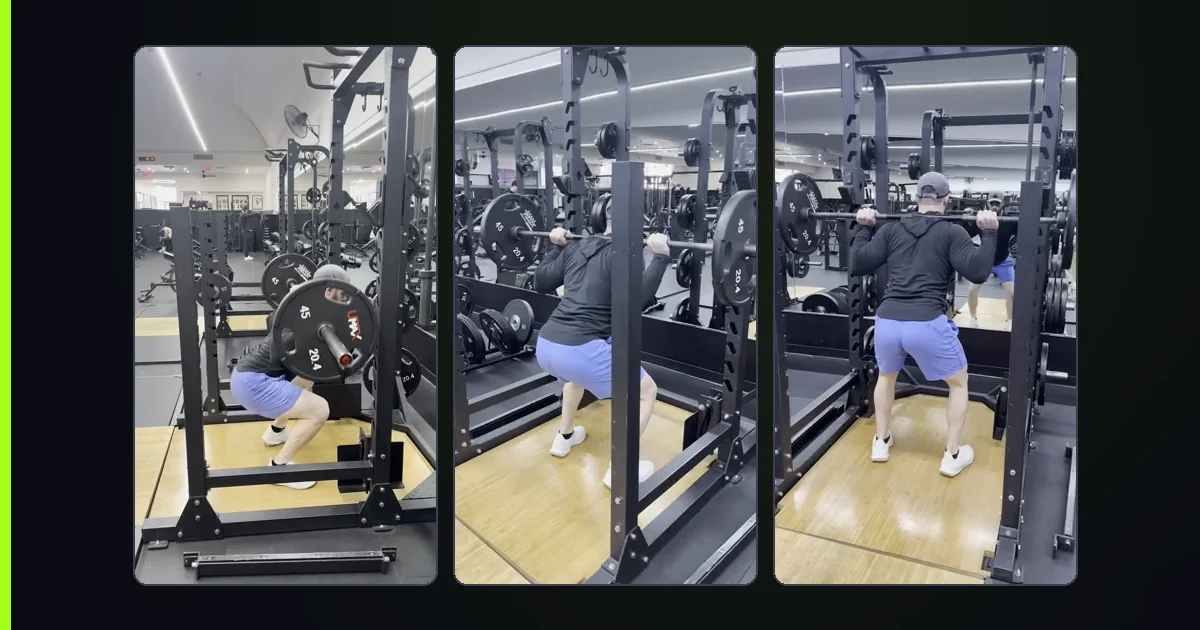
Squat and legs
- Back Squat: Hip crease to or below the top of the knee, then stand to full lockout.
- Front Squat: Bar racked on the shoulders, hip crease to or below the top of the knee, full lockout.
- Barbell Lunge: Back knee lightly touches the floor, front thigh at least parallel, full lockout each rep. Enter the total on the bar.
- Leg Press (45-degree plate-loaded): 45-degree plate-loaded sled. Count plates only, not the sled. Knees to about 90 degrees, hips stay on the seat, full extension.
- Bulgarian Split Squat: Rear foot on a 12 to 16 inch bench, front thigh parallel or lower, full lockout. One dumbbell weight, per hand.
- Dumbbell Walking Lunge: Back knee lightly touches the floor each step, front thigh at least parallel, full lockout. One dumbbell weight, per hand.
- Goblet Squat: One dumbbell or kettlebell held at the chest, hip crease to or below the top of the knee.
Hinge and posterior chain
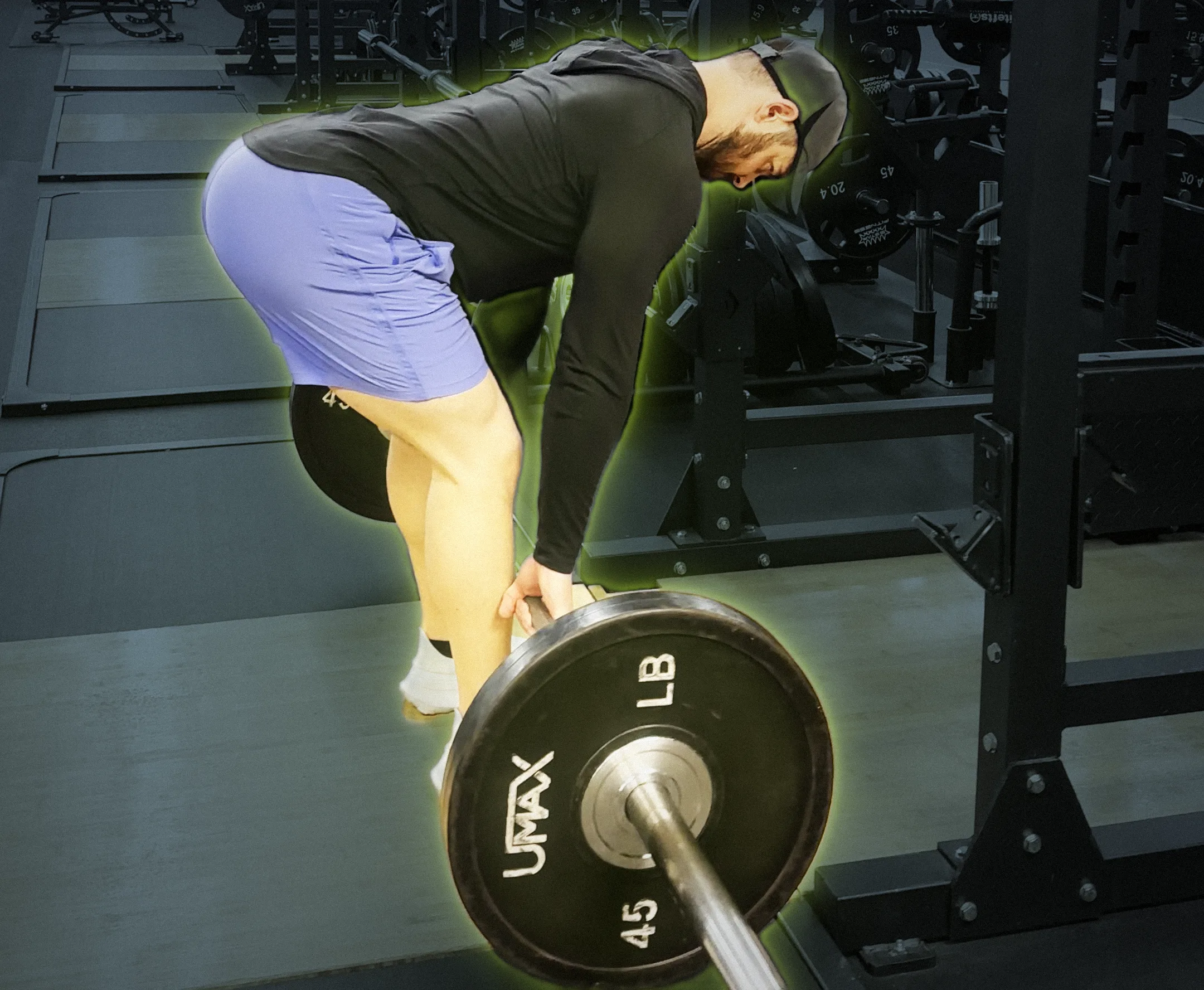
- Deadlift: From the floor, dead stop and reset each rep, full hip and knee lockout. No straps (hook or mixed grip is fine), no hitching.
- Sumo Deadlift: From the floor, dead stop and reset each rep, full lockout. No straps (hook or mixed grip is fine), no hitching.
- Trap Bar Deadlift: Standard (high) handles, from the floor, dead stop each rep, full lockout. No straps.
- Romanian Deadlift: Start standing, lower to mid-shin with a flat back, return to full lockout. No bounce at the bottom.
- Barbell Hip Thrust: Upper back on a bench, bar over the hips, full hip lockout with a 1-second pause at the top. Trained lifters tend to thrust about 1.1 to 1.3 times their squat.
- Power Clean: From the floor, catch with the thighs above parallel, then stand fully.
Pressing
- Bench Press: Bar touches the chest, 1-second pause, no bounce, full lockout.
- Overhead Press: Strict, from the collarbone to full lockout, no leg drive.
- Incline Bench Press: Bench at 30 to 45 degrees, bar touches the upper chest, 1-second pause, no bounce, full lockout.
- Close-Grip Bench Press: Hands about shoulder width, bar touches the lower chest, 1-second pause, full lockout.
- Dumbbell Bench Press: Dumbbells touch the chest or go just below it, brief pause, full lockout. One dumbbell weight, per hand.
- Push Press: Dip and drive with the legs, finish at full lockout overhead with the bar over the mid-foot.
- Dumbbell Shoulder Press: Start at the shoulders, press to full lockout overhead, standing or seated. One dumbbell weight, per hand.
- Dip: Upper arms to parallel or below, full lockout. Enter added weight (0 for bodyweight, negative if assisted).
Pulling and back
- Pull-Up: Dead hang to chin over the bar, no kip. Enter added weight (0 for bodyweight, negative if assisted).
- Chin-Up: Underhand grip, dead hang to chin over the bar, no kip. Enter added weight (0 for bodyweight, negative if assisted).
- Barbell Row: Torso near parallel, bar touches the lower ribs, full arm extension each rep, no body swing.
- Pendlay Row: Bar rests on the floor, pulls to the lower ribs, returns to a dead stop each rep.
- Dumbbell Row: One hand on a bench, pull to the hip, full stretch at the bottom, no torso twist. One dumbbell weight, per hand.
- Barbell Curl: Standing, elbows at the sides, full extension to full contraction, no hip swing.
Grip and carrying
- Farmer's Carry: Heavy handles or dumbbells at your sides, 20 m without setting them down, upright posture. Enter the weight in EACH hand and 1 rep.
- Dead Hang: Overhand shoulder-width grip on a pull-up bar, feet off the floor, arms straight, no swinging. Bare hands, no straps or chalk. Time stops when a hand slips or your feet touch down. Enter the time in seconds.
Only one machine is scored, the 45-degree plate-loaded leg press, because it is close to the same in most gyms. Hack squats and cable stacks differ too much between brands for a standard to mean anything, so they are left out.
Where the numbers come from
This is the part most standards pages skip, so here it is in full.
- Seven lifts are set directly: squat, bench press, deadlift, overhead press, pull-up, farmer's carry and dead hang. The squat and deadlift tiers were checked against competition results in the squat and deadlift standards, which come from OpenPowerlifting. For the 83 kg men's and 63 kg women's classes, Very Strong lands near the 25th percentile of raw powerlifters and Elite near the 75th. Bench press, overhead press, pull-up, carry and dead hang are not checked against meet data.
- Dead hang has the thinnest evidence. No large population norms exist for hang time. One small 2025 study of 25 recreational athletes around age 20 averaged about 64 seconds for men and 48 for women, so the standard sits close to that, at 60 and 45 seconds. Time is not scaled by bodyweight, there is too little data to do that honestly, and age lowers it like every other standard. It is marked low confidence.
- Every other lift is estimated: it takes one of those lifts and multiplies its tiers by a single ratio, for example the front squat at 0.8 of the squat. Nobody has published measured data for lifts like the hip thrust or the dumbbell row, so these are coaching estimates and each is marked with a confidence of high, medium or low.
- Age: the drop after 40 is anchored on published masters powerlifting age coefficients. Ages past 69 are extrapolated and under 23 is a small estimate for lifters still developing. Both are labelled as estimates.
- Execution: the squat and deadlift standards are lifted to meet depth, the same as the competition results they were checked against, which is why the squat is to parallel and the bench is paused.
- Limits: these are not percentiles of a dataset. A tier means a level of strength for a person who trains, not that you are stronger than a given share of people.
All the standards, as a multiple of bodyweight (dead hang in seconds)
The five numbers are the thresholds for Beginner, Solid, Strong, Very Strong and Elite, before the age adjustment. Dumbbell lifts are the weight of one dumbbell. Pull-ups, chin-ups and dips are bodyweight plus added load.
Squat and legs
| Lift | Men | Women | Basis |
|---|---|---|---|
| Back Squat | 0.75x 1.25x 1.60x 2.00x 2.50x | 0.50x 0.85x 1.15x 1.45x 1.95x | Set directly |
| Front Squat | 0.60x 1.00x 1.28x 1.60x 2.00x | 0.40x 0.68x 0.92x 1.16x 1.56x | Estimated, high confidence |
| Barbell Lunge | 0.45x 0.75x 0.96x 1.20x 1.50x | 0.30x 0.51x 0.69x 0.87x 1.17x | Estimated, medium confidence |
| Leg Press (45-degree plate-loaded) | 1.43x 2.38x 3.04x 3.80x 4.75x | 0.95x 1.61x 2.19x 2.75x 3.71x | Estimated, low confidence |
| Bulgarian Split Squat | 0.14x 0.23x 0.29x 0.36x 0.45x | 0.09x 0.15x 0.21x 0.26x 0.35x | Estimated, low confidence |
| Dumbbell Walking Lunge | 0.12x 0.20x 0.26x 0.32x 0.40x | 0.08x 0.14x 0.18x 0.23x 0.31x | Estimated, low confidence |
| Goblet Squat | 0.19x 0.31x 0.40x 0.50x 0.63x | 0.13x 0.21x 0.29x 0.36x 0.49x | Estimated, low confidence |
Hinge and posterior chain
| Lift | Men | Women | Basis |
|---|---|---|---|
| Deadlift | 1.00x 1.50x 1.90x 2.35x 2.85x | 0.75x 1.10x 1.50x 1.85x 2.35x | Set directly |
| Sumo Deadlift | 1.00x 1.50x 1.90x 2.35x 2.85x | 0.75x 1.10x 1.50x 1.85x 2.35x | Estimated, high confidence |
| Trap Bar Deadlift | 1.10x 1.65x 2.09x 2.58x 3.13x | 0.82x 1.21x 1.65x 2.04x 2.58x | Estimated, medium confidence |
| Romanian Deadlift | 0.80x 1.20x 1.52x 1.88x 2.28x | 0.60x 0.88x 1.20x 1.48x 1.88x | Estimated, medium confidence |
| Barbell Hip Thrust | 0.90x 1.50x 1.92x 2.40x 3.00x | 0.60x 1.02x 1.38x 1.74x 2.34x | Estimated, medium confidence |
| Power Clean | 0.55x 0.82x 1.04x 1.29x 1.57x | 0.41x 0.60x 0.82x 1.02x 1.29x | Estimated, medium confidence |
Pressing
| Lift | Men | Women | Basis |
|---|---|---|---|
| Bench Press | 0.60x 0.90x 1.25x 1.60x 2.00x | 0.30x 0.50x 0.70x 0.95x 1.20x | Set directly, medium confidence |
| Overhead Press | 0.40x 0.60x 0.80x 1.00x 1.25x | 0.20x 0.35x 0.50x 0.65x 0.85x | Set directly, medium confidence |
| Incline Bench Press | 0.49x 0.74x 1.02x 1.31x 1.64x | 0.25x 0.41x 0.57x 0.78x 0.98x | Estimated, high confidence |
| Close-Grip Bench Press | 0.54x 0.81x 1.13x 1.44x 1.80x | 0.27x 0.45x 0.63x 0.85x 1.08x | Estimated, medium confidence |
| Dumbbell Bench Press | 0.22x 0.33x 0.46x 0.59x 0.74x | 0.11x 0.18x 0.26x 0.35x 0.44x | Estimated, medium confidence |
| Push Press | 0.48x 0.72x 0.96x 1.20x 1.50x | 0.24x 0.42x 0.60x 0.78x 1.02x | Estimated, medium confidence |
| Dumbbell Shoulder Press | 0.16x 0.24x 0.32x 0.40x 0.50x | 0.08x 0.14x 0.20x 0.26x 0.34x | Estimated, medium confidence |
| Dip | 0.60x 0.90x 1.25x 1.60x 2.00x | 0.30x 0.50x 0.70x 0.95x 1.20x | Estimated, low confidence |
Pulling and back
| Lift | Men | Women | Basis |
|---|---|---|---|
| Pull-Up | 0.85x 1.00x 1.20x 1.45x 1.70x | 0.65x 0.85x 1.00x 1.20x 1.40x | Set directly, medium confidence |
| Chin-Up | 0.89x 1.05x 1.26x 1.52x 1.78x | 0.68x 0.89x 1.05x 1.26x 1.47x | Estimated, medium confidence |
| Barbell Row | 0.48x 0.72x 1.00x 1.28x 1.60x | 0.24x 0.40x 0.56x 0.76x 0.96x | Estimated, medium confidence |
| Pendlay Row | 0.45x 0.68x 0.94x 1.20x 1.50x | 0.23x 0.38x 0.53x 0.71x 0.90x | Estimated, medium confidence |
| Dumbbell Row | 0.24x 0.36x 0.50x 0.64x 0.80x | 0.12x 0.20x 0.28x 0.38x 0.48x | Estimated, medium confidence |
| Barbell Curl | 0.27x 0.41x 0.56x 0.72x 0.90x | 0.14x 0.23x 0.32x 0.43x 0.54x | Estimated, medium confidence |
Grip and carrying
| Lift | Men | Women | Basis |
|---|---|---|---|
| Farmer's Carry | 0.15x 0.30x 0.45x 0.65x 0.85x | 0.10x 0.20x 0.30x 0.45x 0.60x | Set directly, low confidence |
| Dead Hang | 20s 40s 60s 90s 120s | 10s 25s 45s 70s 100s | Set directly, low confidence |
How many pull-ups should you be able to do?
For a man in his twenties or thirties who trains, the standard here is 6 strict pull-ups, and for a woman it is 1. A strict pull-up starts from a dead hang with the arms straight and ends with the chin over the bar, with no kip. The rep counts come from the same bodyweight standards as everything else on this page, so they hold at any bodyweight, and the standard comes down with age. Below the first tier a pull-up is only possible with assistance.
Men: strict pull-ups by age and tier
| Age | Beginner | Solid | Standard | Very Strong | Elite |
|---|---|---|---|---|---|
| 25 | assisted | 1 rep | 6 reps | 13 reps | 21 reps |
| 40 | assisted | 1 rep | 6 reps | 13 reps | 21 reps |
| 50 | assisted | assisted | 2 reps | 8 reps | 15 reps |
| 60 | assisted | assisted | assisted | 2 reps | 8 reps |
| 70 | assisted | assisted | assisted | assisted | 1 rep |
Women: strict pull-ups by age and tier
| Age | Beginner | Solid | Standard | Very Strong | Elite |
|---|---|---|---|---|---|
| 25 | assisted | assisted | 1 rep | 6 reps | 12 reps |
| 40 | assisted | assisted | 1 rep | 6 reps | 12 reps |
| 50 | assisted | assisted | assisted | 2 reps | 7 reps |
| 60 | assisted | assisted | assisted | assisted | 1 rep |
| 70 | assisted | assisted | assisted | assisted | assisted |
How long should you be able to dead hang?
The standard is 60 seconds for a man and 45 for a woman under 40, hanging from a pull-up bar with an overhand grip, feet off the floor and no swinging. These are benchmarks for people who train, not medical cutoffs. They are low confidence because no large study has measured hang time across the population, and the times fall with age.
| Age | Sex | Beginner | Solid | Standard | Very Strong | Elite |
|---|---|---|---|---|---|---|
| 25 | Men | 20 s | 40 s | 60 s | 90 s | 120 s |
| 25 | Women | 10 s | 25 s | 45 s | 70 s | 100 s |
| 40 | Men | 20 s | 40 s | 60 s | 90 s | 120 s |
| 40 | Women | 10 s | 25 s | 45 s | 70 s | 100 s |
| 50 | Men | 18 s | 35 s | 53 s | 80 s | 106 s |
| 50 | Women | 9 s | 22 s | 40 s | 62 s | 89 s |
| 60 | Men | 15 s | 30 s | 45 s | 67 s | 90 s |
| 60 | Women | 7 s | 19 s | 34 s | 52 s | 75 s |
| 70 | Men | 12 s | 24 s | 37 s | 55 s | 73 s |
| 70 | Women | 6 s | 15 s | 27 s | 43 s | 61 s |
More on individual lifts
- Back Squat: Squat standards from meet results
- Bench Press: Jordan's bench press standards guide
- Deadlift: Deadlift standards from meet results
What to do with your results
Look at your weakest movement, not your best lift. A squat two tiers above your pull is a plan for the pull. If you want a program built around the gap, start free in the app and it will match you to one. To work out what to load on the bar for a target, use the plate calculator.
Questions
How are these strength standards calculated?
Each standard is a multiple of your bodyweight. A lift's tiers (Beginner, Solid, Strong, Very Strong, Elite) are set for people who train in gyms, then lowered for age. Your reps are converted to an estimated one-rep max with the Epley formula and compared with those tiers.
Are these standards for average people or for lifters?
For lifters. The tiers describe people who go to the gym and train, not the general public, so Solid is a good result for someone who has trained for a year or two. The squat and deadlift tiers were checked against meet results from OpenPowerlifting: Very Strong sits near the 25th percentile of raw powerlifters and Elite near the 75th.
Is every lift based on real lifter data?
No, and the page marks which are which. Squat, bench press, deadlift and overhead press are set directly and checked against competition data where it exists. Most other lifts are estimated from one of those four using a single ratio, because nobody has published measured data for lifts like the hip thrust or the dumbbell row. Each lift shows its confidence.
How many pull-ups should I be able to do?
A man under 40 who trains meets the standard at 6 strict pull-ups, and a woman at 1. A strict pull-up starts from a dead hang and ends with the chin over the bar. The standard comes down with age, and the full table by age and tier is on this page.
How long should I be able to dead hang?
The standard is 60 seconds for a man and 45 for a woman under 40. It is set near the averages of one small 2025 study of 25 recreational athletes, because no large population norms exist for dead hang time. Treat it as a benchmark for lifters, not a medical cutoff.
What counts as a rep, and how deep do I squat?
Every lift has one written standard so the numbers mean the same thing for everyone. Squats go to parallel, with the hip crease at or below the top of the knee. Bench presses touch the chest with a one-second pause. Deadlifts start from the floor and stop dead each rep. Everything else uses full range of motion, and a rep that misses the standard does not count.
Which machine do I use for the leg press?
The 45-degree plate-loaded leg press, counting the plates only and not the sled. It is the one machine that is close to the same in most gyms. Cable stacks and hack squats are not scored because their weights are not comparable between brands.
How does age change the standards?
Age is a negative adjustment. Standards are the same from 23 to 40, then drop gradually, following the shape of published masters powerlifting age coefficients. Under 23 they are slightly lower too. Ages past 69 are extrapolated, so treat them as estimates.
What does the age projection tell me?
It shows what you would need to lift today to still reach a tier at an older age, under two cases: you keep training, or you lose strength at a typical rate. The keep-training case uses studies of masters powerlifters who kept competing into their 60s, so it is a best case, not a promise.
Which rep ranges do the standards cover?
One, three, five and ten reps. All four come from the same one-rep-max standard using the Epley formula, so they always agree with each other. Estimates get looser past ten reps.